A travel capsule wardrobe is not a test of minimalism or a chance to prove that three garments can solve every climate. It is a way to pack clothes that will meet the days you actually have: early airport air conditioning, a warm afternoon, a restaurant that feels smarter than expected, and a sink wash that is still damp the next morning. The right capsule wardrobe color palette makes those small changes easier because nearly every top, bottom, and layer has somewhere sensible to go.
Choose a palette for the trip you actually have
Begin with the calendar, not an aspirational travel mood board. A four-day city break with museums, walking, and one dinner out needs different packing outfit colors from a beach week or a work trip with presentations. Check the forecast twice: the average temperature is useful, but the morning low, rain chance, wind, and indoor air conditioning explain whether you will need a proper outer layer. A wardrobe that works only in the warmest hour of the day is not a capsule; it is a packing mistake waiting for a jacket.
Then look at the activities by surface and duration. Light trousers might be perfect for a museum afternoon but awkward for a long train ride with a dark seat and a coffee stop. A white linen shirt earns its place in a warm destination if it can become a sun layer, a dinner layer, and a top over a tank. If it only photographs well on day one, it is taking up space that a more useful piece could occupy.
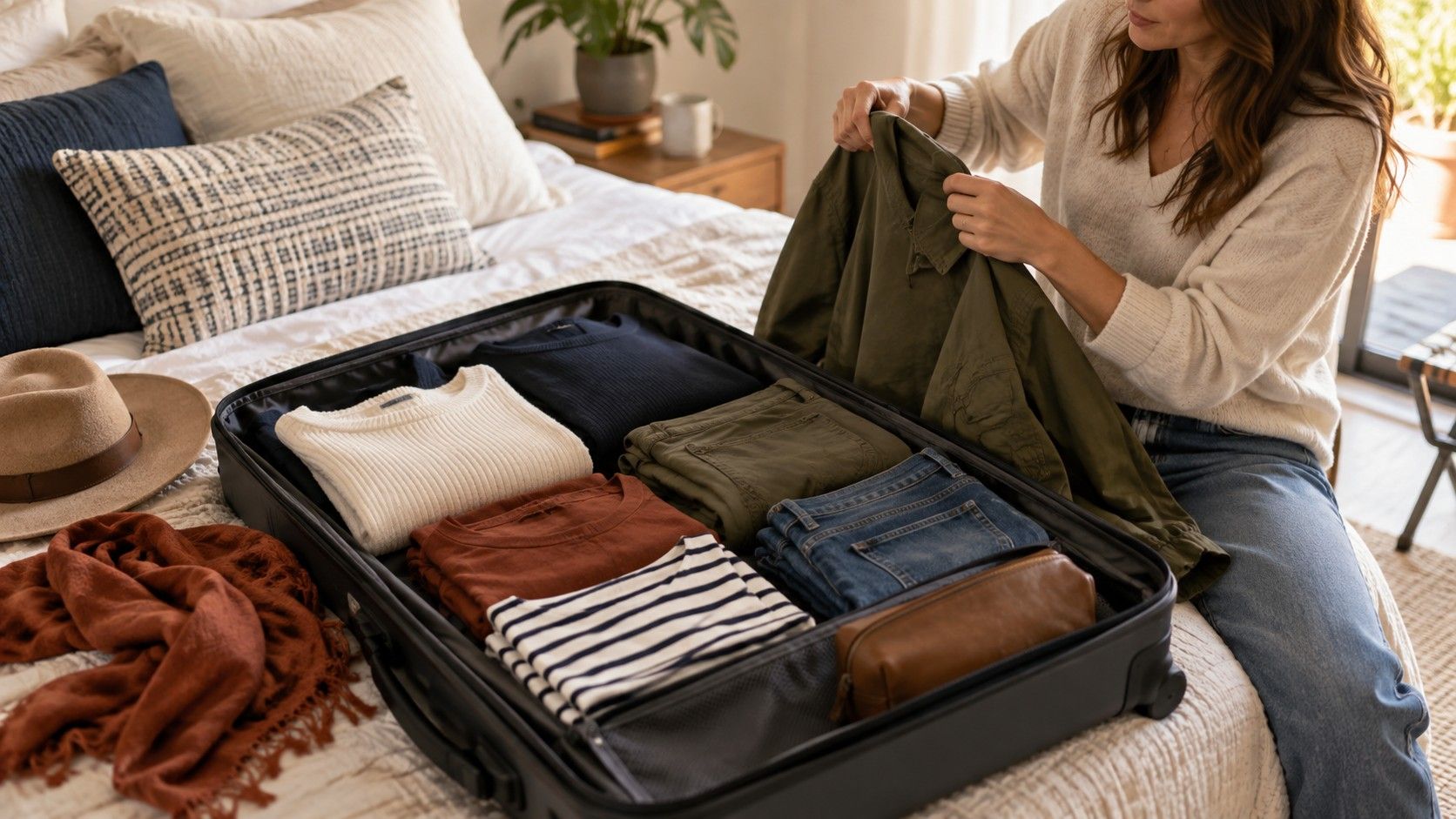
Pick one main neutral, one lighter neutral, and one or two colors you genuinely enjoy wearing. Navy with ecru and faded blue is a reliable formula; olive with cream and rust works well for dry, warm places; charcoal with white and muted berry is good for cooler cities. The number matters less than the connection. Every color should pair with both bottoms and at least one shoe, otherwise it becomes a lonely item that needs a special outfit.
Pick a base neutral that travels well
The best base neutral is often the one that hides a little evidence of travel without looking tired. Navy, charcoal, olive, medium denim, chocolate, and taupe handle station dust, a crowded flight, and a second wear more calmly than optic white or very pale beige. Black can be useful, especially for evening, but an all-black capsule sometimes becomes visually heavy when you are carrying a black coat, black trainers, and a black backpack as well.
Make the base neutral do repeated work in your two bottoms and outer layer. For example, navy trousers, dark blue jeans, and a navy overshirt allow a cream tee, striped shirt, red knit, or pale blue blouse to move around freely. The pieces do not need to match exactly. In fact, a slight difference between ink navy, washed denim, and midnight blue makes the wardrobe look less like a uniform while retaining the easy pairing.
Shoes are part of this decision, not an afterthought. One pair in white, cream, tan, or dark brown can connect many travel capsule wardrobe colors. If you pack a second pair, give it a different purpose: weatherproof boots, sandals, or a smarter flat. Two almost identical black shoes create less flexibility than two shoes that each solve a real problem.
| Trip situation | Base neutral | Accent colors that travel well |
|---|---|---|
| Cool city, variable rain | Charcoal or navy | Light blue, soft red, forest green |
| Warm city with evening plans | Olive or medium denim | Cream, coral, saffron, navy |
| Coastal trip with layers | Stone or dark blue | White, faded blue, terracotta |
| Work trip with carry-on only | Navy or chocolate | Ivory, pale blue, burgundy |
Add only a small number of colors you will miss if they stay home
Accents keep a capsule from becoming a row of sensible but forgettable basics. The trick is to choose colors with more than one route through the bag. A rust knit can sit over a white tee, under a navy coat, and beside olive trousers. A bright pink top may be wonderful, but if it only works with one pair of jeans and demands a particular lipstick or shoe, it may not be the color to take on a short trip.
Use prints carefully. A stripe that includes your base neutral and one accent behaves almost like a solid, which is why it is so useful in capsule wardrobe outfits. A large floral print can still travel, but it should be able to pair with both bottoms and the outer layer. Hold it beside the shoes before packing. If the pattern and shoe immediately argue, you will probably skip that combination while away.
Accessories can carry a color that would be too expensive in clothing space. A scarf, cap, compact bag, or earrings can repeat a berry, cobalt, or orange note without requiring a matching trouser. They also rescue a repeated base outfit on day three. One colorful scarf makes the same navy layer look different over a cream tee and a striped shirt, which is more useful than packing a second bulky jumper.
Make each layer earn more than one job
Layers should connect the colors rather than interrupt them. If your base is navy and cream, a camel coat, medium blue overshirt, or olive utility jacket can bridge the two without becoming a separate palette. Test the layer over every top before it goes into the carry-on. A jacket that only works over one dress or one knit is rarely worth the weight unless the trip has a specific occasion attached to it.
Pay attention to fabric drying time. A cotton tee can often be washed and worn again quickly; heavy denim and thick knitwear may not be ready after an overnight hotel-room dry. This is where color and laundry meet. Packing two dark tops that can take a second wear is often more useful than carrying three pale tops that show every splash. A travel capsule wardrobe is allowed to be practical; nobody awards points for doing laundry in a tiny bathroom.
Try the layers at the temperature transition you expect most. Stand outside in the coat, then remove it in a heated room. If the under-layer is too thin, too sheer, or a color you would not choose on its own, the system is not finished. A good outer layer is not camouflage for a weak outfit; it is an additional option that can come off without leaving you stranded.
Test the outfits before packing, then edit one piece
Lay every item on the bed and make actual combinations rather than counting theoretical possibilities. Three tops, two bottoms, one outer layer, and two shoes can create plenty of looks when the palette is connected, but only if the proportions also work. Try the trousers with each top, then add the jacket. Check whether both shoes make sense with both bottoms. The awkward pairing is often the clue that one piece belongs back in the wardrobe at home.
Take quick photos in daylight. This reveals a common travel problem: two garments that looked different in a drawer may be almost identical once layered, while a supposedly neutral top may pull too yellow against your other colors. You do not need a perfect grid of outfits. You need enough combinations that a spill, weather change, or dinner invitation does not force a last-minute shopping trip.
Finally, leave a little empty space in the bag. It gives you room for a layer you are wearing when you board, laundry that has not quite dried, or a small purchase that genuinely fits the palette. The most successful capsule wardrobe color palette is not the most rigid one. It is the one that makes departure mornings calmer and lets you spend less time negotiating with your suitcase when you would rather be outside.